Polynomials

Polynomials
Polynomials are algebraic expressions that contain indeterminates and constants. You can think of polynomials as a dialect of mathematics. They are used to express numbers in almost every field of mathematics and are considered very important in certain branches of math, such as calculus. For example, 2x + 9 and x2 + 3x + 11 are polynomials.
A polynomial looks like this:
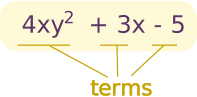 |
| example of a polynomial this one has 3 terms |
Polynomial comes from poly- (meaning "many") and -nomial (in this case meaning "term") ... so it says "many terms"
The degree of the polynomials is determined by the highest exponent. Various operations like addition, subtraction, multiplication and division can be applied on polynomials.
What are Polynomials?
Polynomials are mathematical expressions made up of variables and constants by using arithmetic operations like addition, subtraction, and multiplication. They represent the relationship between variables.
In polynomials, the exponents of each of the variables should be a whole number. The exponents of the variables in any polynomial have to be a non-negative integer. A polynomial comprises constants and variables, but we cannot perform division operations by a variable in polynomials.
Standard Form of a Polynomial
P(x) = anxn + an-1xn-1 +an-2xn-2 + ………………. + a1x + a0
Where an, an-1, an-2, ……………………, a1, a0 are called coefficients of xn, xn-1, xn-2, ….., x and constant term respectively and it should belong to real number (⋲ R).
Notation
The polynomial function is denoted by P(x) where x represents the variable. For example,
P(x) = x2-5x+11
If the variable is denoted by a, then the function will be P(a)
Polynomial Examples
Let us understand this by taking an example: 3x2 + 5. In the given polynomial, there are certain terms that we need to understand. Here, x is known as the variable. 3 which is multiplied to x2 has a special name. We denote it by the term "coefficient". 5 is known as the constant. The power of the variable x is 2.
Below given are a few expressions that are not examples of a polynomial.
| Not a Polynomial | Reason |
|---|---|
| 2x-2 | Here, the exponent of variable 'x' is -2. |
| 1/(y + 2) | This is not an example of a polynomial since division operations in a polynomial cannot be performed by a variable. |
| √(2x) | The exponent cannot be a fraction (here, 1/2) for a polynomial. |
The following image shows all the terms in a polynomial.

Degree of a Polynomial
The highest or greatest exponent of the variable in a polynomial is known as the degree of a polynomial. The degree is used to determine the maximum number of solutions of a polynomial equation (using Descartes' Rule of Signs).
Example 1: A polynomial 3x4 + 7 has a degree equal to four.
The degree of the polynomial with more than one variable is equal to the sum of the exponents of the variables in it.
Example 2: Find the degree of the polynomial 3xy.
In the above polynomial, the power of each variable x and y is 1. To calculate the degree in a polynomial with more than one variable, add the powers of all the variables in a term. So, we will get the degree of the given polynomial (3xy) as 2.
Similarly, we can find the degree of the polynomial 2x2y4 + 7x2y by finding the degree of each term. The highest degree would be the degree of the polynomial. In this example:
- The degree of 2x2y4 is 2 + 4 = 6 and
- The degree of 7x2y is 2 + 1 = 3
- Among these, 6 is the bigger number and hence it is the degree of the polynomial 2x2y4 + 7x2y.
Standard Form of Polynomials
The standard form of a polynomial refers to writing a polynomial in the descending power of the variable.
Example: Express the polynomial 5 + 2x + x2 in the standard form.
To express the above polynomial in standard form, we will first check the degree of the polynomial.
- In the given polynomial, the degree is 2. Write the term containing the degree of the polynomial.
- Now, we will check if there is a term with the exponent of variable less than 2, i.e., 1, and note it down next.
- Finally, write the term with the exponent of the variable as 0, which is the constant term.
Therefore, 5 + 2x + x2 in standard form can be written as x2 + 2x + 5.
Always remember that in the standard form of a polynomial, the terms are written in decreasing order of the power of the variable, here, x.
Terms of a Polynomial
The terms of polynomials are defined as the parts of the expression that are separated by the operators "+" or "-". For example, the polynomial expression 2x3 - 4x2 + 7x - 4 consists of four terms. The terms are classified into two types: like terms and unlike terms.
Like terms in polynomials are those terms which have the same variable and same power. Terms that have different variables and/or different powers are known as unlike terms. Hence, if a polynomial has two variables, then all the same powers of any ONE variable will be known as like terms. Let us understand these two with the help of examples given below.
For example, 2x and 3x are like terms. Whereas, 3y4 and 2x3 are unlike terms.
The terms of polynomials are the parts of the expression that are generally separated by “+” or “-” signs. So, each part of a polynomial in an expression is a term. For example, in a polynomial, say, 2x2 + 5 +4, the number of terms will be 3. The classification of a polynomial is done based on the number of terms in it.
Types of Polynomials
Polynomials can be categorized based on their degree and their power. Based on the numbers of terms, there are mainly three types of polynomials that are listed below:
Monomial is a type of polynomial with a single term. For example, x, -5xy, and 6y2. A binomial is a type of polynomial that has two terms. For example, x + 5, y2 + 5, and 3x3 - 7. While a Trinomial is a type of polynomial that has three terms. For example 3x3 + 8x - 5, x + y + z, and 3x + y - 5. However, based on the degree of the polynomial, polynomials can be classified into 4 major types:
- Zero Polynomial: It a polynomial whose degree is equal to zero.
- Constant polynomial: It is a polynomial with just a constant and no variables. For example 3, 5, or 8, etc.
- Linear polynomial: It is a polynomial with degree 1. Example: x + y - 4.
- Quadratic polynomial: It is a polynomial with degree 2. Example: 2p2 - 7.
- Cubic polynomial: It is a polynomial with degree 3. Example: 6m3 - mn + n2 - 4.
A trinomial is an expression which is composed of exactly three terms. A few examples of trinomial expressions are:
- – 8a4+2x+7
- 4x2 + 9x + 7
Properties of Polynomials
A polynomial expression has terms connected by the addition or subtraction operators. There are different properties and theorems on polynomials based on the type of polynomial and the operation performed. Some of these are as given below,
Theorem 1: If A and B are two given polynomials then,
- deg(A ± B) ≤ max(deg A, deg B), with the equality if deg A ≠ deg B
- deg(A⋅B) = deg A + deg B
Theorem 2: Given polynomials A and B ≠ 0, there are unique polynomials Q (quotient) and R (residue) such that,
A = BQ + R and deg R < deg B
Theorem 3 (Bezout's Theorem): Polynomial P(x) is divisible by binomial x − a, if and only if P(a) = 0. This is also known as the factor theorem.
Theorem 4: If a polynomial P is divisible by a polynomial Q, then every zero of Q is also a zero of P.
Theorem 5: Polynomial P(x) of degree n > 0 has a unique representation of the form P(x) = k(x - x1)(x - x2)...(x - xn), where k ≠ 0 and x1,…,xn are complex numbers, not necessarily distinct.
Therefore, P(x) has at most deg P = n different zeros.
Theorem 6: Polynomial of n-th degree has exactly n complex/real roots along with their multiplicities.
Theorem 7: If a polynomial P is divisible by two coprime polynomials Q and R, then it is divisible by Q⋅R.
Theorem 8: If ß is a complex zero of a real polynomial P(x), then so is (complex conjugate of ß).
Theorem 9: A real polynomial P(x) has a unique factorization (up to the order) of the form,
P(x) = (x - r1)...(x - rk)(x2 - p1x + q1)...(x2 - plx + ql),
where ri and pj, qj are real numbers with pi2 < 4qi and k + 2l = n.
Theorem 10 (Remainder Theorem): The remainder when a polynomial f(x) is divided by (x - a) is f(a).
Theorem 11 (Rational Root Theorem): A rational root of a polynomial functional f(x) = an xn + an-1xn-1 + ... + a2x2 + a1x + a0 is of the form p/q, where p is a factor of a0 and q is a factor of an. This theorem is very helpful in finding the rational zeros of a polynomial.
Properties
Some of the important properties of polynomials along with some important polynomial theorems are as follows:
Property 1: Division Algorithm
If a polynomial P(x) is divided by a polynomial G(x) results in quotient Q(x) with remainder R(x), then,
P(x) = G(x) • Q(x) + R(x)
Where R(x)=0 or the degree of R(x) < the degree of G(x)
Property 2: Bezout’s Theorem
Polynomial P(x) is divisible by binomial (x – a) if and only if P(a) = 0.
Property 3: Remainder Theorem
If P(x) is divided by (x – a) with remainder r, then P(a) = r.
Property 4: Factor Theorem
A polynomial P(x) divided by Q(x) results in R(x) with zero remainders if and only if Q(x) is a factor of P(x).
Learn More: Factor Theorem
Property 5: Intermediate Value Theorem
If P(x) is a polynomial, and P(x) ≠ P(y) for (x < y), then P(x) takes every value from P(x) to P(y) in the closed interval [x, y].
Learn More: Intermediate Value Theorem
Property 6
The addition, subtraction and multiplication of polynomials P and Q result in a polynomial where,
Degree(P ± Q) ≤ Degree(P or Q)
Degree(P × Q) = Degree(P) + Degree(Q)
Property 7
If a polynomial P is divisible by a polynomial Q, then every zero of Q is also a zero of P.
Property 8
If a polynomial P is divisible by two co-prime polynomials Q and R, then it is divisible by (Q • R).
Property 9
If P(x) = a0 + a1x + a2x2 + …… + anxn is a polynomial such that deg(P) = n ≥ 0 then, P has at most “n” distinct roots.
Property 10: Descartes’ Rule of Sign
The number of positive real zeroes in a polynomial function P(x) is the same or less than by an even number as the number of changes in the sign of the coefficients. So, if there are “K” sign changes, the number of roots will be “k” or “(k – a)”, where “a” is some even number.
Property 11: Fundamental Theorem of Algebra
Every non-constant single-variable polynomial with complex coefficients has at least one complex zero.
Property 12
If P(x) is a polynomial with real coefficients and has one complex zero (x = a – bi), then x = a + bi will also be a zero of P(x). Also, x2 – 2ax + a2 + b2 will be a factor of P(x).
Operations on Polynomials
The basic algebraic operations can be performed on polynomials of different types. These four basic operations on polynomials can be given as,
- Addition of polynomials
- Subtraction of polynomials
- Multiplication of polynomials
- Division of polynomials
Addition of Polynomials
Addition of polynomials is one of the basic operations that we use to increase or decrease the value of polynomials. Whether you wish to add numbers together or you wish to add polynomials, the basic rules remain the same. The only difference is that when you are adding, you align the appropriate place values and carry the operation out. However, when dealing with the addition of polynomials, one needs to pair up like terms and then add them up. Otherwise, all the rules of addition from numbers translate over to polynomials. Have a look at the image given here in order to understand how to add any two polynomials.

Subtraction of Polynomials
As discussed above, the rules for the subtraction of polynomials are very similar to subtracting two numbers. To subtract a polynomial from another, we just add the additive inverse of the polynomial that is being subtracted to the other polynomial. Another easy way to subtract polynomials is, just to change the signs of all the terms of the polynomial to be subtracted and then add the resultant terms to the other polynomial as shown below. We just have to align the given polynomials based on the like terms.

Multiplication of Polynomials
The multiplication operation on polynomials follows the general properties like commutative property, associative property, distributive property, etc. Applying these properties using the rules of exponents we can solve the multiplication of polynomials. To multiply to polynomials, we just multiply every term of one polynomial with every term of the other polynomial and then add all the results. Here is an example to multiply polynomials.
For example, (2x + 3y)(4x - 5y) = 2x(4x - 5y) + 3y(4x - 5y) = 8x2 - 10xy + 12xy - 15y2
⇒ (2x + 3y)(4x - 5y) = 8x2 + 2xy - 15y2
Example: Solve (6x−3y)×(2x+5y)
Solution:
⇒ 6x ×(2x+5y)–3y × (2x+5y) ———- Using distributive law of multiplication
⇒ (12x2+30xy) – (6yx+15y2) ———- Using distributive law of multiplication
⇒12x2+30xy–6xy–15y2 —————– as xy = yx
Thus, (6x−3y)×(2x+5y)=12x2+24xy−15y2
Division of Polynomials
The division of polynomials is an arithmetic operation where we divide a given polynomial by another polynomial which is generally of a lesser degree in comparison to the degree of the dividend. There are two methods to divide polynomials.
To learn more about each type of division, click on the respective link.
Polynomial Division Steps:
If a polynomial has more than one term, we use long division method for the same. Following are the steps for it.
- Write the polynomial in descending order.
- Check the highest power and divide the terms by the same.
- Use the answer in step 2 as the division symbol.
- Now subtract it and bring down the next term.
- Repeat steps 2 to 4 until you have no more terms to carry down.
- Note the final answer, including remainder, will be in the fraction form (last subtract term).
Factorization of Polynomials
Factorization of polynomials is the process by which we decompose a polynomial expression into the form of the product of its irreducible factors, such that the coefficients of the factors are in the same domain as that of the main polynomial. There are different techniques that can be followed for factoring polynomials, given as,
- Method of Common Factors
- Grouping Method
- Factoring by Splitting Terms
- Factoring Using Algebraic Identities
Based on the complexity of the given polynomial expression, we can follow any of the above-given methods.
Polynomial Equations
A polynomial equation is an equation formed with variables, exponents, and coefficients together with operations and an equal sign. The general form of a polynomial equation is P(x) = an xn + . . + a1x + a0. Some examples of polynomial equations are x2 + 3x + 2 = 0, x3 + x + 1 = 0, x + 7 = 0, etc.
Solving polynomial equations is to find the value of the variable that satisfies the equation.
Polynomial Functions
The general expressions containing variables of varying degrees, coefficients, positive exponents, and constants are known as polynomial functions. In other words, a polynomial function is a function whose definition is a polynomial. Here are some examples of polynomial functions:
- f(x) = x2 + 4
- g(x) = -2x3 + x - 7
- h(x) = 5x4 + x3 + 2x2
A single-variable polynomial having degree n has the following equation:
anxn + an-1xn-1 + … + a2x2 + a1x1 + a0x0
In this, a’s denote the coefficients whereas x denotes the variable. Since x1 = x and x0 = 1 considering all complex numbers x. Therefore, the above expression can be shortened to:
anxn + an-1xn-1 + … + a2x2 + a1x + a
When an nth-degree of single-variable polynomial equals to 0, then the resultant polynomial equation of degree ‘n’ acquires the following form:
anxn + an-1xn-1 + … + a2x2 + a1x + a = 0
Solving Polynomials
Solving a polynomial means finding the roots or zeros of the polynomials. We can apply different methods to solve a polynomial depending upon the type of the polynomial, whether it is a linear polynomial, quadratic polynomial, and so on. Let us first understand what is meant by the zero of a polynomial.
Zeros of Polynomials
The roots or zeros of polynomial are the real values of the variable for which the value of the polynomial would become equal to zero. So, if we say any two real numbers, ‘α’ and ‘ß’ are zeroes of polynomial p(x), then p(α) = 0 and p(ß) = 0. For example, for a polynomial, p(x) = x2 - 2x + 1, we observe, p(1) = (1)2 - 2(1) + 1 = 0. Therefore, 1 is a zero or root of the given polynomial. This also means that (x - 1) is a factor of p(x).
Now, to find the zero or root of any polynomial, that is, to solve any polynomial, we can apply different methods,
- Factorization
- Graphical Method
- Hit and Trial Method
Important Notes on Polynomials:
- Terms in a polynomial can be only separated by the '+' or '-' sign.
- For any expression to become a polynomial, the power of the variable should be a whole number.
- The addition and subtraction of a polynomial are possible between like terms only.
- All the numbers in the universe are called constant polynomials.
Solving Linear Polynomials
Getting the solution of linear polynomials is easy and simple. First, isolate the variable term and make the equation as equal to zero. Then solve as basic algebra operation. An example of finding the solution of a linear equation is given below:
Example: Solve 3x – 9
Solution:
First, make the equation as 0. So,
3x – 9 = 0
⇒ 3x = 9
⇒ x = 9/3
Or, x = 3.
Thus, the solution of 3x-9 is x = 3.
Solving Quadratic Polynomials
To solve a quadratic polynomial, first, rewrite the expression in the descending order of degree. Then, equate the equation and perform polynomial factorization to get the solution of the equation. An example to find the solution of a quadratic polynomial is given below for better understanding.
Example: Solve 3x2 – 6x + x3 – 18
Solution:
First, arrange the polynomial in the descending order of degree and equate to zero.
⇒ x3 + 3x2 -6x – 18 = 0
Now, take the common terms.
x2(x+3) – 6(x+3) =0
⇒ (x2-6)(x+3)=0
So, the solutions will be x =-3 or
x2 = 6
Or, x = ±√6
Polynomial Examples
Example:
Given two polynomial 7s3+2s2+3s+9 and 5s2+2s+1.
Solve these using mathematical operation.
Solution:
Given polynomial:
7s3+2s2+3s+9 and 5s2+2s+1
Polynomial Addition: (7s3+2s2+3s+9) + (5s2+2s+1)
= 7s3+(2s2+5s2)+(3s+2s)+(9+1)
= 7s3+7s2+5s+10
Hence, addition result in a polynomial.
Polynomial Subtraction: (7s3+2s2+3s+9) – (5s2+2s+1)
= 7s3+(2s2-5s2)+(3s-2s)+(9-1)
= 7s3-3s2+s+8
Hence addition result in a polynomial.
Polynomial Multiplication:(7s3+2s2+3s+9) × (5s2+2s+1)
= 7s3 (5s2+2s+1)+2s2 (5s2+2s+1)+3s (5s2+2s+1)+9 (5s2+2s+1))
= (35s5+14s4+7s3)+ (10s4+4s3+2s2)+ (15s3+6s2+3s)+(45s2+18s+9)
= 35s5+(14s4+10s4)+(7s3+4s3+15s3)+ (2s2+6s2+45s2)+ (3s+18s)+9
= 35s5+24s4+26s3+ 53s2+ 21s +9
Polynomial Division: (7s3+2s2+3s+9) ÷ (5s2+2s+1)
(7s3+2s2+3s+9)/(5s2+2s+1)
This cannot be simplified. Therefore, division of these polynomial do not result in a Polynomial.
Polynomials in One Variable
Polynomials in one variable are algebraic expressions that are of the form axn where n is a non-negative (i.e. positive or zero) integer and a is a real number, called the coefficient of the term. The degree of a polynomial in one variable is the largest exponent in the polynomial.
What are Polynomials in One Variable?
Polynomials in one variable are those expressions in which there is only one variable present. In mathematics, a polynomial is an expression that consists of variables and coefficients, involving the operations of addition, subtraction, multiplication, and exponentiation of variables. The word "polynomial" contains two words, namely, “poly" and “nomials”. "Poly" means many, and "nomials" means terms. Hence an expression containing many terms is called polynomials, having variables and coefficients.

Some examples of polynomials in one variable are given below:
- x2 + 3x − 2
- 3y3 + 2y2 − y+ 1
- m4 − 5m2 + 8m − 3
Classification of Polynomials in One Variable
To learn about the classification of one variable polynomial based on degree, let us first understand the meaning of the degree of a polynomial. The highest power of the variable in a polynomial is called the degree of the polynomial. For example, in the following equation: x2 + 2 x + 4, the degree of the polynomial is 2, i.e., the highest power of the variable in the polynomial.
Based on the degree of a polynomial in one variable, it can be classified into 4 types:
- Zero or constant polynomial
- Linear polynomial
- Quadratic polynomial
- Cubic polynomial
For a multivariable polynomial, the degree is the highest sum of powers of different variables in any of the terms in the expression.
Zero or Constant Polynomial
A polynomial having 0 as the degree of the polynomial is termed as zero or constant polynomial. Such polynomials only have constant terms with no variable. 2, which we can also write as 2x0, is an example of zero polynomial.
Linear Polynomial
A polynomial with 1 as the degree of the polynomial is termed a linear polynomial. Linear polynomials can have multiple variables. So, we consider linear polynomial in one variable as a type of polynomial in one variable. Examples - x + 7, 3y − 27, 7z + 17/2
Quadratic Polynomial
A quadratic polynomial is a polynomial of degree 2, i.e, the highest exponent of the variable is 2. Examples - x2 + 7x + 12, 2m2 − 5m + 32, 8y2 − 2
Cubic Polynomial
A cubic polynomial is a polynomial of degree 3, i.e, the highest exponent of the variable is 3. Examples - 4y3 − 8, x3 + 5x2 − 6x − 4, 5z3 − 3/4
How to Solve Polynomials in One Variable?
Solving polynomials refers to finding their roots. A root or zero of a polynomial is the value for which the given polynomial is equal to zero. The first step in solving any polynomial is to find its degree. As discussed above the degree of a polynomial with one variable is the largest exponent of that variable. Thus,
- Linear polynomials can have multiple variables but these polynomials have only one solution.
- Quadratic polynomials in one variable have only two solutions possible.
- Cubic polynomials in one variable have only three solutions possible.
References
- Barbeau, E.J. (2003). Polynomials. Springer. ISBN 978-0-387-40627-5.
- Bronstein, Manuel; et al., eds. (2006). Solving Polynomial Equations: Foundations, Algorithms, and Applications. Springer. ISBN 978-3-540-27357-8.
- Cahen, Paul-Jean; Chabert, Jean-Luc (1997). Integer-Valued Polynomials. American Mathematical Society. ISBN 978-0-8218-0388-2.
- Horn, Roger A.; Johnson, Charles R. (1990). Matrix Analysis. Cambridge University Press. ISBN 978-0-521-38632-6..
- Lang, Serge (2002), Algebra, Graduate Texts in Mathematics, vol. 211 (Revised third ed.), New York: Springer-Verlag, ISBN 978-0-387-95385-4, MR 1878556. This classical book covers most of the content of this article.
- Leung, Kam-tim; et al. (1992). Polynomials and Equations. Hong Kong University Press. ISBN 9789622092716.
- Mayr, K. (1937). "Über die Auflösung algebraischer Gleichungssysteme durch hypergeometrische Funktionen". Monatshefte für Mathematik und Physik. 45: 280–313. doi:10.1007/BF01707992. S2CID 197662587.
- McCoy, Neal H. (1968), Introduction To Modern Algebra, Revised Edition, Boston: Allyn and Bacon, LCCN 68015225
- Prasolov, Victor V. (2005). Polynomials. Springer. ISBN 978-3-642-04012-2.
- Sethuraman, B.A. (1997). "Polynomials". Rings, Fields, and Vector Spaces: An Introduction to Abstract Algebra Via Geometric Constructibility. Springer. ISBN 978-0-387-94848-5.
Comments
Post a Comment